
Google Ads vs Facebook Ads: Which Is Better in 2026?
Google Ads vs Facebook Ads: Which Is Better for Your Business?
Choosing between Google Ads and Facebook Ads is not simply about cost. The right choice depends on what you sell, customer discovery, urgency, campaign objective, creative resources, and conversion tracking.
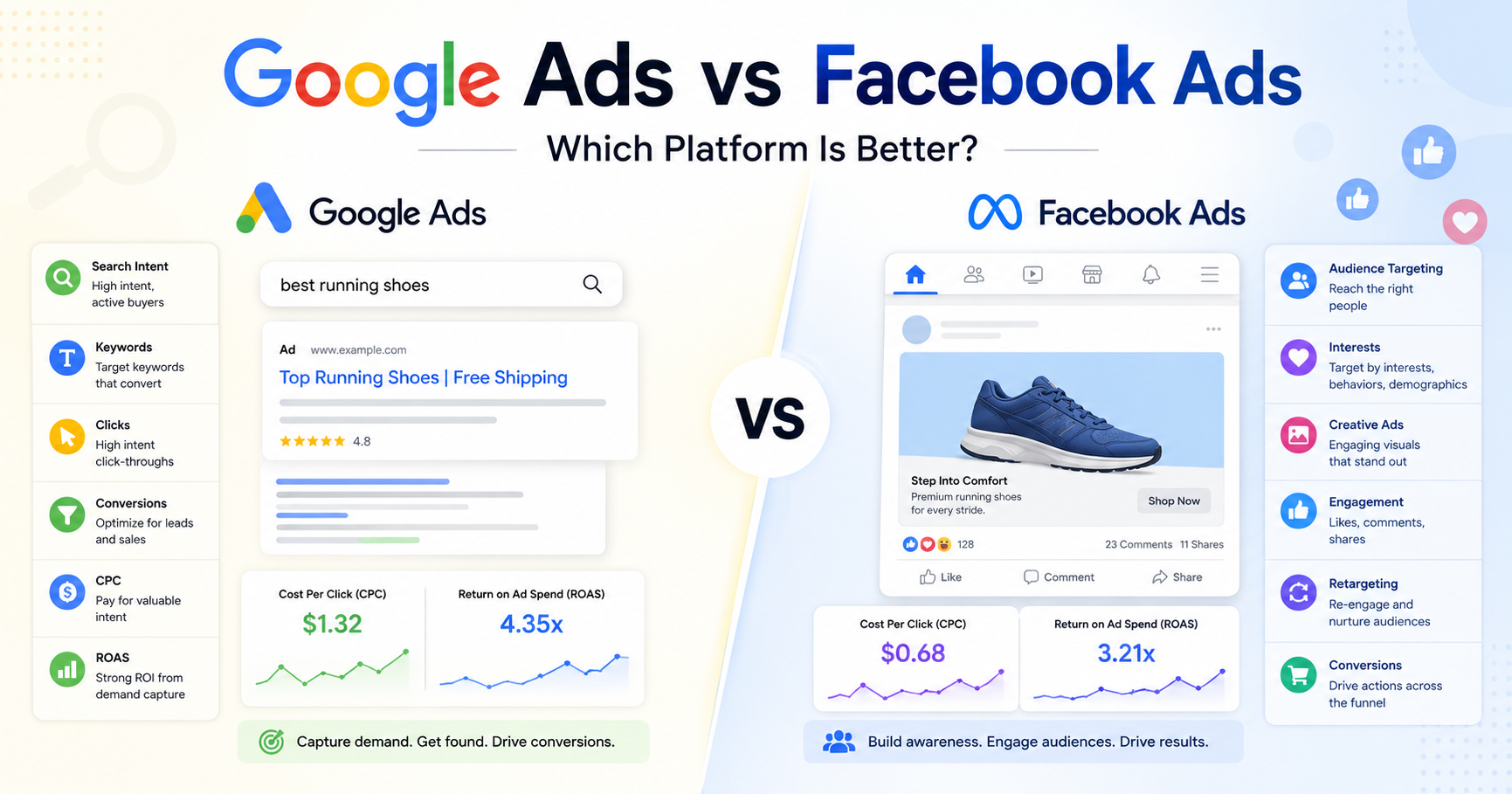
The clearest distinction is this: Google Ads is generally strongest at capturing existing demand, while Facebook Ads—managed through Meta Ads Manager—is generally strongest at creating and shaping demand. Google Search can reach people actively looking for a product or service. Meta Ads can introduce an offer to selected audiences across Facebook, Instagram, Messenger, and other eligible placements.
For many businesses, the best solution is using each platform where it contributes most in the customer journey.
Google Ads vs Facebook Ads at a Glance
| Comparison area | Google Ads | Facebook/Meta Ads |
|---|---|---|
| Primary strength | Captures active search intent | Generates awareness and demand |
| Targeting foundation | Keywords, queries, audiences and intent | Audiences, interests, behaviour and customer data |
| Popular placements | Search, Shopping, YouTube, Display and Maps | Facebook, Instagram, Messenger and eligible Meta placements |
| Strongest creative | Search copy, product listings, video and multi-channel assets | Images, Reels, Stories, video and carousels |
| Common use cases | High-intent leads, urgent services and product searches | Brand discovery, visual products and retargeting |
| User mindset | “I am looking for this” | “This looks relevant to me” |
Google describes Search campaigns as a way to reach people while they search for products and services. Performance Max can access inventory across Search, YouTube, Display, Discover, Gmail and Maps. Meta’s ad auction optimises delivery around the selected campaign objective.
What Is Google Ads?
Google Ads is a paid advertising platform that helps businesses appear across Google-owned and partner inventory. Its best-known format is the Search ad.
Search campaigns use keywords and other signals to connect ads with relevant searches. This makes Google advertising valuable when people already understand their need. A query such as “emergency plumber near me” demonstrates commercial intent.
Important campaign types include Search, Shopping, Display, Video, Demand Gen, App and Performance Max. Performance Max is a goal-based campaign type that gives advertisers access to Google Ads inventory from one campaign.
Google also offers Smart Bidding strategies such as Target CPA, Target ROAS, Maximise Conversions and Maximise Conversion Value.
Advantages of Google Ads
High-intent traffic: Search advertising reaches users who are actively expressing a need.
Keyword-level control: Campaigns can be organised around keywords, search themes, match types and negative keywords.
Measurable actions: Google Ads works well for calls, enquiries, purchases, bookings and other trackable conversions.
Multiple formats: Search captures demand, Shopping promotes products, YouTube builds awareness and Performance Max expands reach across Google inventory.
Google’s Quality Score is a Search-campaign diagnostic based on expected click-through rate, ad relevance and landing-page experience. Use it for diagnosis, not as a replacement for cost per acquisition or return on ad spend.
What Are Facebook Ads or Meta Ads?
Facebook Ads are part of Meta’s advertising ecosystem and are created through Meta Ads Manager. Advertisers can run campaigns across eligible placements on Facebook, Instagram, Messenger and other Meta surfaces.
Instead of depending mainly on a search query, Meta Ads use signals such as location, age, interests, behaviour, previous engagement and first-party customer data.
Advertisers can create Custom Audiences for retargeting and Lookalike Audiences to reach people who resemble valuable customers.
Meta Ads Manager uses six broad objectives: Awareness, Traffic, Engagement, Leads, App promotion and Sales. The chosen objective guides Meta’s auction towards people who are more likely to take the desired action.
Meta also provides Advantage+ tools that use AI across audiences, placements, budgets and creative optimisation.
Advantages of Facebook Ads
Demand generation: Meta can introduce a product before people actively search for it.
Visual storytelling: Images, Reels, Stories, carousels and video can demonstrate products and outcomes.
Audience discovery: Businesses can explore broad, interest-based, engagement, customer and lookalike audiences.
Retargeting: Campaigns can reconnect with website visitors, video viewers, social engagers and customer lists.
Creative testing: Advertisers can compare hooks, offers, formats and visual concepts.
Meta’s Advantage+ audience combines advertiser inputs with AI-powered expansion while allowing strict controls such as location, minimum age, language and exclusions.
Key Differences Between Google Ads and Facebook Ads
1. Search Intent vs Audience Discovery
On Google Search, the user starts the interaction by entering a query. This gives the advertiser a clearer signal of immediate intent.
On Facebook or Instagram, the advertiser usually starts discovery by placing relevant creative in a feed, Story or Reel.
Google Ads is often better for:
- Urgent services
- High-intent lead generation
- Local enquiries
- Bottom-of-funnel campaigns
- Products people already search for
Facebook Ads is often better for:
- New or unfamiliar products
- Brand awareness
- Visually appealing offers
- Emotional or lifestyle purchases
- Top-of-funnel campaigns
This is why the difference between Google Ads and Facebook Ads is often described as demand capture versus demand generation.
2. Keyword Targeting vs Audience Targeting
Google Search campaigns rely heavily on search behaviour, queries and keywords. Performance depends on keyword selection, negative keywords, relevant ad copy and a landing page that satisfies search intent.
Meta campaigns focus more heavily on people and predicted behaviour. Advertisers can use broad targeting, detailed targeting, Custom Audiences, Lookalike Audiences and Advantage+ audience tools.
In simple terms:
Google Ads asks: What is this person searching for? Facebook Ads asks: Who is this person, and what are they likely to respond to?
This distinction also explains the broader difference between paid search and paid social advertising.
3. Text-Led vs Creative-Led Performance
Google Search Ads rely on relevant headlines, descriptions, assets and landing-page alignment. The message must closely match the query and provide a clear reason to click.
Facebook and Instagram Ads depend more on scroll-stopping creative. The opening visual, first line, hook, offer, proof and call to action strongly influence results.
Meta also needs regular creative variation because repeated exposure can cause creative fatigue.
Both platforms need strong copy, but the creative requirements differ. Google Search rewards relevance to intent, while Meta rewards attention and audience resonance.
4. Google Ads vs Facebook Ads Cost
There is no universal winner in a Google Ads vs Facebook Ads cost comparison.
Google Search may have a higher cost per click in competitive industries because advertisers are bidding for active commercial intent. Meta may generate cheaper impressions or clicks, but inexpensive traffic is not useful when it fails to produce qualified leads or sales.
Compare both platforms using:
- Cost per click — CPC
- Cost per thousand impressions — CPM
- Cost per qualified lead — CPL
- Cost per acquisition — CPA
- Conversion rate
- Lead-to-sale rate
- Customer acquisition cost — CAC
- Return on ad spend — ROAS
- Customer lifetime value — LTV
Meta states that campaign cost depends on several factors and that there is no one-size-fits-all budget. Costs on either platform vary by market, objective, audience, offer, competition and creative quality.
Therefore, asking “Which is cheaper, Google Ads or Facebook Ads?” is less useful than asking which platform produces profitable customers.
5. Measurement and Attribution
Reliable conversion tracking is essential on both platforms.
Google Ads conversion tracking measures meaningful actions such as sales and leads after ad interactions. Meta Pixel records browser-side website events, while the Conversions API creates a direct connection between business data and Meta’s optimisation systems.
For better measurement, define primary conversions, track qualified leads rather than only form submissions, pass purchase values for e-commerce, use consistent UTM parameters and connect CRM outcomes where possible.
Compare platform reports with GA4 and backend revenue instead of evaluating everything through last-click attribution.
Businesses should also consider:
- Cross-channel attribution
- View-through conversions
- Click-through conversions
- Offline conversion tracking
- Enhanced conversions
- First-party data
- Server-side tracking
- Conversion windows
- Which Platform Is Better for Your Business?
- Google Ads vs Facebook Ads for Lead Generation
Google Ads is usually the first platform to test when customers actively search for the service.
Examples include:
- Legal services
- Home repairs
- Professional courses
- Healthcare appointments
- Local services
- B2B software
Search campaigns can capture prospects when their need is immediate and clearly expressed.
Facebook Ads can work well when audiences need education, the offer is visually demonstrable or an instant lead form reduces friction. It is also useful for retargeting previous visitors.
The best platform for lead generation should be selected using lead quality and sales outcomes, not only the number of submitted forms.
Google Ads vs Facebook Ads for E-commerce
Google Shopping and Search are valuable when shoppers already know the product category or brand they want.
Facebook and Instagram Ads are useful for:
- Product discovery
- Demonstrations
- Creator-style content
- Customer testimonials
- Product bundles
- Retargeting
- New collection launches
An e-commerce brand can use Meta to create interest, Google to capture later product searches and both platforms to reconnect with non-buyers.
For e-commerce campaigns, evaluate revenue, profit margin, average order value, repeat purchase rate and ROAS rather than focusing only on traffic.
Google Ads vs Facebook Ads for Small Businesses
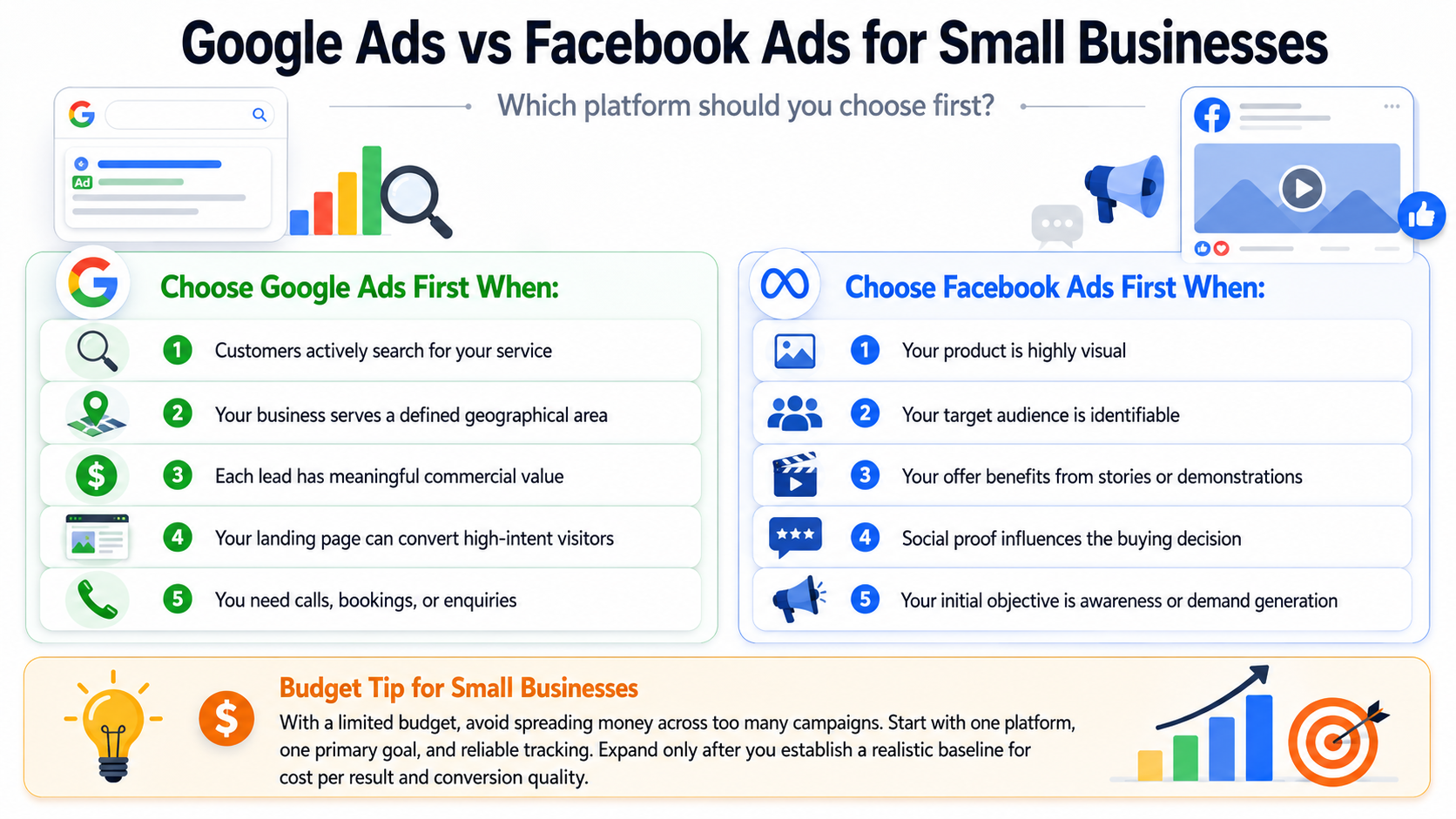
Choose Google Ads first when:
- Customers actively search for your service.
- The business serves a defined geographical area.
- Each lead has meaningful commercial value.
- The landing page can convert high-intent visitors.
- You need calls, bookings or enquiries.
Choose Facebook Ads first when:
- The product is highly visual.
- The target audience is identifiable.
- The offer benefits from stories or demonstrations.
- Social proof can influence the buying decision.
- The initial objective is awareness or demand generation.
With a limited budget, avoid spreading money across too many campaigns. Start with one platform, one primary goal and reliable tracking.
Expand after you establish a realistic baseline for cost per result and conversion quality.
Google Ads vs Facebook Ads for B2B
Google Search is commonly effective for B2B products with identifiable search demand. It can capture decision-makers researching software, consulting, training or professional services.
Meta can support B2B campaigns when the target audience can be reached through educational content, customer lists, Lookalike Audiences, retargeting or founder-led creative.
However, B2B advertisers should consider the complete sales cycle. A low-cost lead is not valuable when it does not match the target company, role, budget or buying intent.
Should You Use Google Ads and Facebook Ads Together?
Using both platforms can create a stronger full-funnel advertising strategy.
A potential workflow is:
- Meta Ads introduce the brand through educational or visual creative.
- Interested users visit the website or engage with the brand.
- Google Search captures people who later search for the brand, product or solution.
- Meta retargeting reminds non-converters about the offer.
- Google remarketing or Performance Max supports further conversion opportunities.
- CRM and revenue data reveal which channels influence valuable customers.
This combines demand generation with demand capture and gives each platform a defined job.
Your advertising copy should remain consistent across the funnel while adapting to the user’s awareness level.
A cold Meta audience may need a strong hook and explanation. A high-intent Google Search user may need a direct benefit, relevant offer and action-focused call to action.
Final Verdict: Google Ads or Facebook Ads?
Choose Google Ads when you want to capture existing demand from people actively looking for a product, service or solution.
Choose Facebook Ads when you want to build awareness, reach relevant audiences, demonstrate a visual offer or create demand before people begin searching.
Choose both when you have enough budget, dependable tracking and a clear role for each platform.
Base the decision on customer intent, campaign objective, creative resources, sales cycle and unit economics—not on the assumption that one platform is always better.
Frequently Asked Questions
Which is better, Google Ads or Facebook Ads?
Google Ads is often better for active search intent and immediate demand. Facebook Ads is often better for audience discovery, visual storytelling and demand generation. The better platform depends on your business goal.
Is Google Ads cheaper than Facebook Ads?
Not necessarily. Facebook Ads may produce cheaper impressions or clicks, while Google Ads may deliver higher-intent traffic. Compare cost per qualified lead, acquisition and revenue rather than CPC alone.
Which platform is better for small businesses?
Google Ads can suit local and service businesses with existing search demand. Facebook Ads can suit visual, lifestyle and discovery-led businesses. Start with the platform that matches how customers find your offer.
Can Facebook Ads and Google Ads work together?
Yes. Meta Ads can introduce and retarget, while Google Ads captures searches created by awareness. Coordinated messaging and cross-platform measurement can improve the overall customer journey.
Which platform provides better targeting?
Google provides strong intent and keyword-based targeting. Meta provides extensive audience, engagement and customer-data options. They solve different targeting problems.
Which platform generates better leads?
Google Search may generate higher-intent leads when users actively need the service. Meta can generate strong lead volume when the offer, audience, creative and follow-up process are aligned. Measure quality through CRM and sales data.